What We Need National Leadership On
The most durable parts of this work do not belong to any single state. The shared standard, the common tools, the public benchmark, the open feed to the model companies, and the evaluation and safety functions that get dropped when a team runs lean all point to a tier above the individual state. This report makes the case for national leadership on that shared layer: what it would own, why it has to stay neutral, and why funding it once is cheaper than letting fifty states each pay for it badly. It also describes the state-level counterpart that layer depends on, which is a steward inside each state who gets organizations ready and points the building work at the needs that matter.
About the cohort. We ran a cohort of legal help website teams for 18 months, working together on common approaches to AI for legal help online. Where these reports say “the cohort,” that is who they mean.
Across these reports, the same conclusion keeps surfacing. The strongest place to shape how the models behave is the content the field puts in front of them. The field can ground those models in real state content and measure whether the result is any good. The assets to do that work exist, and a team of any size can start. And the most valuable parts of all of it do not sit inside any one state.
The open feed that reaches the public through the model companies needs a publisher. The public benchmark that holds vendors accountable needs a neutral keeper, because a vendor cannot grade its own test. The shared standard that lets Illinois and Texas content work together needs an owner who keeps it current. The evaluation and safety functions that fall through the cracks at a lean team need somewhere to be carried. Every one of these points up, to a tier above the individual state, and that tier does not yet exist. This is the work that needs national leadership.
The floor that exists today
Through Legal Help Commons, the field has begun running common-tool working groups, on knowledge bases, on voice intake, and on OCR and data extraction, and it is learning from them. Each one forms around a shared problem, runs a focused workstream, and produces a shared artifact, on a monthly cadence with low overhead. The issue-area verticals, the groups organized around housing, debt, reentry, and public benefits, have just launched and are recruiting their first members. This working-group model is a floor rather than a building. It runs on volunteer time and convening goodwill, which means it can produce a standard, a classifier, and a set of rubrics, and it cannot guarantee that those things are maintained for the next decade, certified for the field to rely on, or funded so that the work does not depend on whoever has spare hours that month. The field needs a tier with the resources to do what a volunteer effort cannot.
The statewide steward
Inside each state, someone has to carry this work, and that is the argument of A Call for Statewide Legal Help AI Stewards. If AI is going to advance access to justice rather than deepen the justice gap, the public-interest legal field needs more than speculation and pilots, and what it needs is statewide stewardship. Every state needs specific people and institutions who wake up each morning responsible for two things.
AI readiness and vision. The steward gets organizations knowledgeable, specific, and proactive about where AI can responsibly improve outcomes for people with legal problems and improve the performance of services. That means translating AI into service-level opportunities instead of vague innovation, running short targeted training sessions for leaders and teams, co-designing workflow pilots with clear review and safety protocols, and talking about risks in specific, technically informed ways that protect users and organizations without falling into inaction over ill-defined concern. Organizations that do this are in charge of the change rather than passive recipients of vendor pitches or media narratives.
Encouraging and aligning the building work. The steward gets vendors, builders, researchers, and benchmark makers on the same page about concrete needs, matches them with service teams, and guides, funds, evaluates, and communicates so that the right tools get built and adopted. In practice that means publishing needs briefs by portfolio, structuring pilots with data, milestones, evaluation, and governance, contributing to benchmarks, datasets, and red-teaming so the field learns together, and communicating results frankly.
Steward is a role rather than a job title, and different kinds of groups can carry it depending on how a state is organized. Access to justice commissions, bar associations, and bar foundations convene stakeholders, fund statewide initiatives, and set standards. Legal aid executive directors, or consortia of them, have the authority to coordinate practice areas and operations. Court innovation offices and judicial councils lead technology, self-help, and rules-of-court implementations. University labs and legal tech nonprofits have capacity for research, evaluation, data stewardship, and prototyping. Regional collaboratives bring a track record of shared infrastructure. The common denominator is local trusted relationships, coordination power, and delivery focus.
A steward works at the team level rather than the organization level. The useful questions are who is doing eviction defense, who helps people with no-fault divorce filings, who handles reasonable accommodation letters for tenants, and who runs the reentry clinic or the expungement help line. Stewardship organizes a statewide network of named teams and named services, because the teams that share a workflow also share data, documents, and audiences, which is what makes a shared tool worth building.
Stewards working alone would repeat each other, so the essay also sets out the habits that connect them. Stewards take part in a regular virtual cohort that runs as a research and development loop, where each session surfaces what was tried, what worked, and what failed. Instead of inventing new frameworks in every state, they lean on common platforms for evaluation, datasets, and reusable workflows, contributing test cases and localized content, adopting shared rubrics and disclosure patterns, and publishing results in a comparable format. Each steward publishes a concise yearly report covering progress, obstacles, datasets contributed, tools piloted or adopted and those intentionally rejected, equity and safety findings, and priorities for the coming year. Because those reports follow a common outline, they are comparable across states and can be aggregated nationally.
The shared layer this report argues for and the statewide steward are two ends of the same work. A national tier keeps the standard, the benchmark, and the open feed current and funded. A steward puts them to use in one state, with named teams, their own data, and their own decisions about what to adopt. Neither one accomplishes much without the other.
The full essay also sets out what a steward does month to month, the zones in which to brainstorm AI opportunities with legal teams, and what success could look like in twelve to eighteen months. Read A Call for Statewide Legal Help AI Stewards.
What national leadership would own
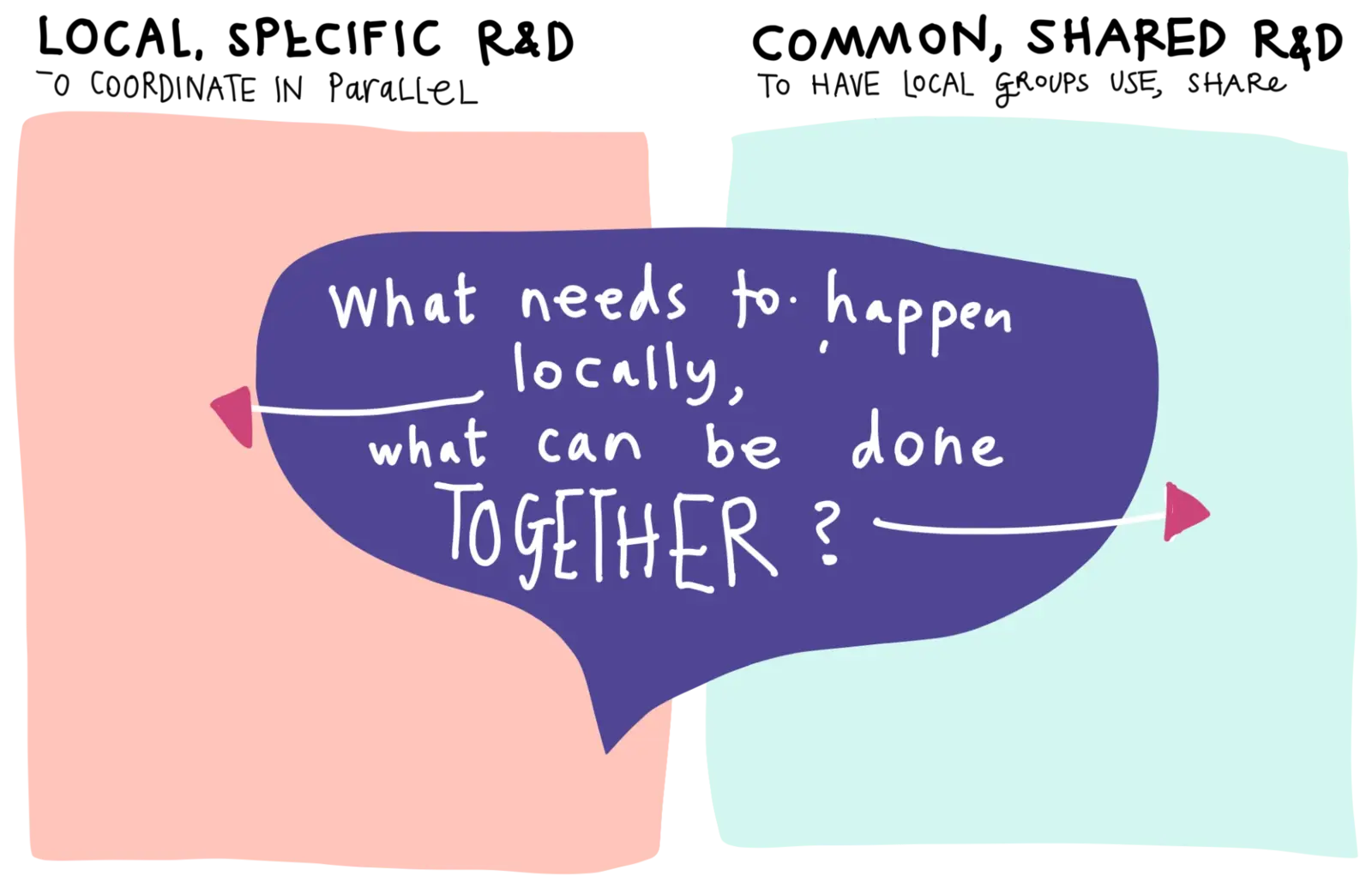
A resourced national body would carry five functions, and each one is the long-term home for something these reports have already shown the field needs.
Standard-setting. It would own the Legal Help Knowledge Standard and its evolution, the LIST taxonomy, a shared way to record eligibility, which is still to be built, the rubric library, and the failure-mode registry. It would publish change notes when something updates and run a deprecation cycle when a field moves. This is the long-term home for the vocabularies the toolkit report catalogs, and it matters because a taxonomy that no one maintains drifts out of date as the law changes, and a standard with no owner quietly forks into incompatible local versions.
Shared tooling. It would maintain the LIST classifier, the content safety wrapper schema and its starter scenarios, the synthetic document dataset, the federation gateway, and the evaluation harness templates. This is the home for the tools the toolkit report catalogs, and it matters because a classifier needs retraining as the models underneath it change, and a safety wrapper needs new scenarios as new high-risk situations surface, and neither happens on its own.
Quality and certification. It would run the benchmark evaluations on the tools the field uses, publish the results, and certify tools and organizations against the standards. This is the home for the public benchmark the strategy and measurement guides describe, and it is the answer to the neutral-keeper problem, because the benchmark only means something if the body that runs it has no tool of its own in the rankings. It also gives a procurement officer a concrete number to require.
Coordination. It would convene the cohorts, run cross-cohort gatherings, keep the working groups connected, and host the publication of the artifacts. This is the connective tissue that keeps the field learning together instead of in parallel silos.
Funding flow. It would pool funding so that individual states are not each fundraising for the same shared infrastructure, and so that a single investment can be made once, at scale, with confidence that the work is being stewarded. This is the function that makes the other four sustainable, and it is the one the field most conspicuously lacks today.
None of this exists yet. It is a proposal for the field and its funders to weigh, not a plan anyone has adopted, and it does not assume any one organization as the home.
Why this should be funded once
The case is concrete, and it comes down to arithmetic. Right now, when a state wants its content tagged with LIST codes, or wants a safety wrapper for its chatbot, or wants to know whether a vendor's tool is any good, it either does without or it raises money to solve the problem for itself. Multiply that across the states, and the field is paying many times over for the same classifier, the same wrapper, and the same benchmark, and paying for them badly, because no single state has the scale to do any of them well. The shared layer is no one's job, so it is chronically underbuilt.
A national tier changes the arithmetic. A single investment, at scale, keeps the standard current, the tools maintained, the benchmark credible, and every state out of the business of reinventing the same infrastructure. The model companies are a counterpart in this, because the open feed and the public benchmark are what the field offers them, as the strategy report described, and someone has to keep those alive for the offer to mean anything. The money that sustains the shared tier is the money that keeps the field at the table with the companies on its own terms, rather than dependent on whatever those companies decide to build without it.
What to do
For a state team reading this, the first moves are small and they are available this week. Locate yourself honestly on the journey from the getting-started report, knowing that most teams are between Stage two and Stage three. Pick one function to invest in next quarter, and if you do not already have knowledge stewardship covered, start there. Pick one task to evaluate, with the document explainer as the easiest first AI task and brief advice as the highest-impact and highest-risk one. Adopt the shared standard on everything you publish from now on, even at the minimum of jurisdiction, LIST code, last-updated date, license, and provenance, and backfill the rest at your own pace. Join a working group, and tell the field what you find, because the practice of sharing what works and what does not, in a form another team can use, travels further than any single tool.
That invitation extends to your own projects, and not only to what you find using the shared assets. Several teams are building notable tools of their own, and those are theirs to describe, because the team that built the work is the one that should tell its story. If your team wants its project written up so the field can see it and learn from it, you are invited to write it up in your own words, and it can be featured so others can find it.
These reports opened on a plain fact, which is that the foundation models are answering the public's legal questions today, whether the field participates or not. Everything since has been about how the field gets those models to do that work well, across the whole range of tasks people need, and how it knows when they do. The field can build the content, the standard, the evidence, and the tools, and the work has started. What no one can do, state by state and grant by grant, is steward all of it for the long run. That is the work that needs national leadership and the resources to sustain it. The companies will keep doing this work either way. The only open question is whether the field meets them with a maintained standard, a credible benchmark, and an open feed it controls, or with a set of good prototypes and no one to keep them alive.