
The Future of Legal Help Design Workshop
The Legal Help Commons team is currently holding in-person and online workshops with frontline experts and community members. The workshop is for people who work on legal help every day: court self-help staff, legal aid advocates, help center managers, technologists, and the people who fund them.
Teams form around a scenario card. Each scenario names a person with a legal problem, the legal outcome that would resolve it, and the outcome that matters in that person's life. A team stays with that one person's situation for the whole afternoon, which keeps the conversation on a service someone could actually use.
What happens in each session
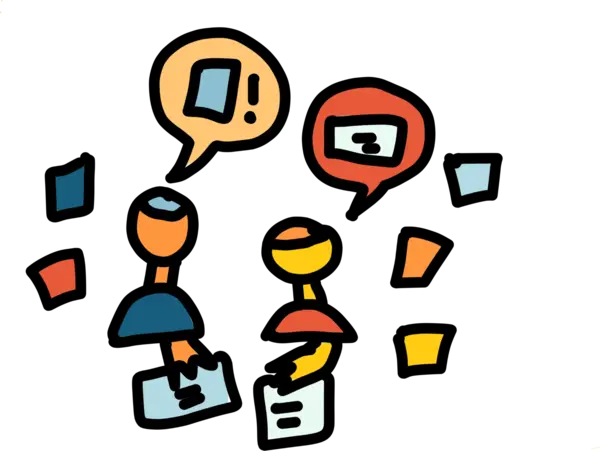
In the first session a team reads its scenario and works through one story of how the service treats that person today. Then the team redesigns it. People move the steps around, change who does each one, and say where technology belongs.
In the second session the team looks closely at the technology. Each team tests its idea against the other groups, then writes it up as a scoped vision: what a system would do, who would use it, and the standards it would have to meet.
Every team finishes with that scoped vision, written as a call to builders and funders. It becomes a candidate entry in the Legal Help Commons, so people who were not in the room can read it and build on it.
How the room and the workshop website work together
Facilitators lead each part of the afternoon with slides, and each group keeps the workshop website open on a laptop. The team does the design work on paper, and the website is where the team writes down what it decided, so the ideas and the feedback stay with the Commons after the paper goes home. Everything a team writes saves under its group name, and nobody has to give an email address.
What a team works from
Teams choose from the scenario library, which holds the problems the Commons is considering taking on as priorities for technology development.
Each scenario card names a person, their situation, the legal outcome they want, and the outcome that matters in their life. Behind each card is a fuller write-up with one story of how the service works for them today, including where people drop out of it. Those stories are drafts written for people to argue with, and the arguing is part of the workshop.
The scenario library
The library holds every scenario the Commons has written, across housing, debt collection, public benefits, and reentry. Anyone can read it without a password.
Read the scenarios
The workshop website
Each group uses the workshop website during the session. It shows the challenge and the scenario the team picked, and it is where the team writes down what it decided. You can look at the website a workshop is using now.
Open the workshop website
Where the work goes afterwards
The Legal Help Commons uses what teams make at a workshop. The proposals become candidate entries in the agenda, the feedback helps decide which workflows the working groups take on next, and we may describe a session’s results in papers, presentations, and reports.
We ask for professional opinions about how legal help services and technology should work, and we do not ask about anyone's own experiences or their clients. We do not use participants' names, we photograph the maps and notes rather than people's faces, and we ask people to keep client names and case details off the materials. Anyone who would rather their contribution were left out can tell a facilitator and still take part. Questions go to legaldesignlab@law.stanford.edu.
Bringing a workshop to your group
The same workshop works for other groups. It was built for a court help center, and it suits a state legal aid network, a conference track, a funder convening, or a working group that wants to scope a tool before anyone builds it.
A host provides a room with space for small groups, an afternoon, and people who know the service being redesigned. We bring the facilitation, the slides, the scenario cards, the workshop website, and the write-up afterwards. If your group has a scenario of its own, we can write a card for it instead of using one from the library.
Write to legaldesignlab@law.stanford.edu to talk about holding one. Tell us roughly how many people, what kind of legal help they work on, and when you would want to hold it.