Debt collection
Challenge missing proof of the debt
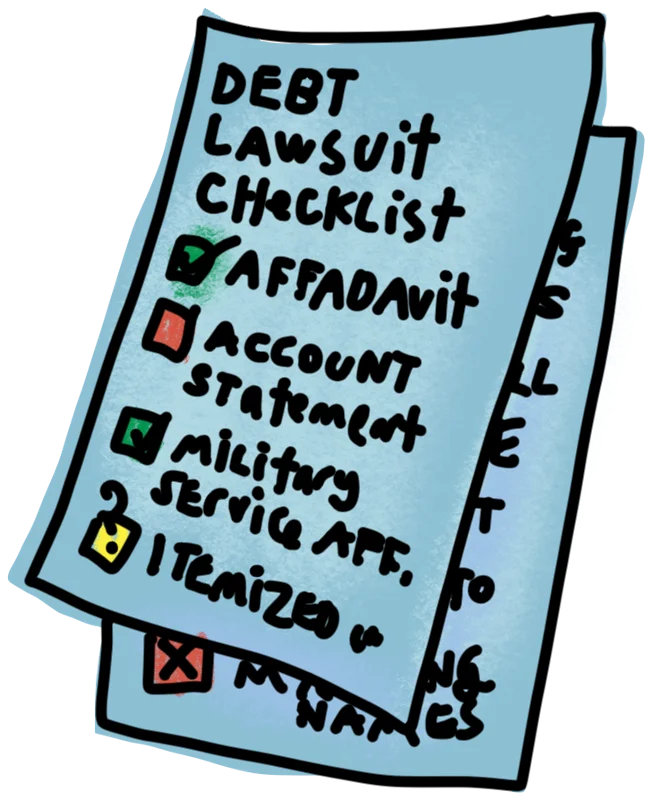
A debt buyer is suing Sam with 1 affidavit and no account records.
Sam. Sam is being sued by a debt buyer over a phone bill from years ago. The complaint attaches a one-page affidavit, with no contract, no account statements, and no record of how the debt was sold. Sam does not know that the company has to prove it owns the debt and that the amount is right.
- Legal outcome they want
- The court sees the debt buyer has not proved its case, and it is dismissed.
- Life outcome they want
- Sam does not pay a debt nobody can prove. His money goes to rent and food.
The problem
People sued by debt buyers can face complaints with thin evidence: a short affidavit and a balance, with no contract, no account statements, and no record of how the debt changed hands. People reading the complaint can assume the company has everything it needs, since it is the one suing. They may not know that the company carries the burden of proving that it owns the debt and that the amount is right.
The legal outcome
The legal outcome is a court that sees what the collector has and has not proved, and then dismisses the case or limits the judgment to what is proven. Reaching it can involve raising standing and chain of title in the answer, requesting documents, objecting to evidence at the hearing, and asking the judge to apply the rules of evidence. Each of these steps depends on knowing what documents a collector should have and noticing when they are missing.
The life outcome
The life outcome is people paying only debts that are shown to be theirs, in the amount actually owed, and keeping their money for rent and food. It also supports trust that courts hold every party to the same standard of proof. How could the evidence behind each claim be visible to both the person and the court before a judgment is entered?
One story of how this service works today
Where this story ends todayJudgments are often entered on paperwork that would not prove the debt.
- The personReads the complaint and assumes it is accurate
- Off-the-shelf techCalls the number on the collection letter
- Community, family, or navigatorHis brother-in-law says the company must have records
- Expert helperA clinic attorney spots the missing chain of title
- Specialized techSends a discovery request through e-filing
- The personAppears in court without the right objections
Where people drop offPeople call the collector instead of responding, and the missing proof is rarely raised in court.
A dashed step is one where people drop out of this story.
This is one story of how the service works today. It is a draft written for people to react to and change, and another place will look different.